Box Spread ETFs vs. SGOV: BOXX, XBOX and CBOX Compared
Comparison · Nov 20, 2026 · 9 min read
#box spread#BOXX#XBOX#CBOX#SGOV#T-bills#cash alternative#tax efficiencyRead in Korean →
Contents ▾
BOXX has grown into a $14 billion fund by doing something unusual for a cash alternative: over the past year, it didn't pay a single distribution. 🤔 Yet its total return was right in line with T-bill ETFs like SGOV. So where did the interest go? In this post we'll explain the box spread BOXX is built on, look at where the return shows up (distributions vs. price), walk through the tax trade-offs, and compare the newer XBOX and CBOX with SGOV. 📚
📦 What's a box spread?
A box spread combines four options so that the payoff at expiration is fixed in advance. It's worth the same amount whether the index goes up or down, so it works like lending money and collecting interest.
Say the S&P 500 is at 6,050. You place all four trades at once (illustrative numbers).
| Trade | Option | Strike |
|---|---|---|
| 1️⃣ Buy | Call | 6,000 |
| 2️⃣ Sell | Call | 6,100 |
| 3️⃣ Buy | Put | 6,100 |
| 4️⃣ Sell | Put | 6,000 |
- 🎯 At expiration, it's worth the gap between the strikes (100 points), wherever the index ends up. S&P 500 options carry a $100 multiplier, so that's $10,000.
- 💵 You pay a little less today. With three months to go, you might pay around $9,900. That $100 difference is your interest, about 1% for three months, or roughly 4% a year.
- 🔁 When it expires, roll into the next one. BOXX mostly rolls boxes that expire in one to three months.
It's easier to see in a chart. Add a call spread (①), which pays off when the index rises, to a put spread (②), which pays off when it falls, and the ups and downs cancel out. The payoff becomes one flat line. 📐
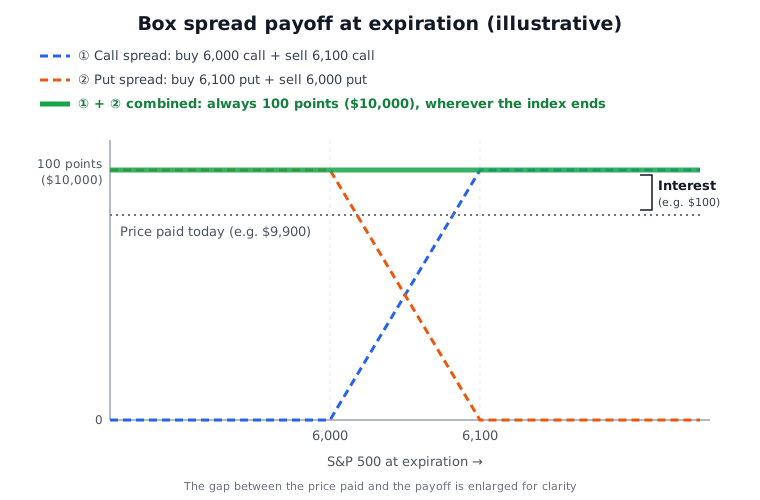
Think of it as buying a $10,000 gift card for $9,900 that you can redeem in three months. 🎟️ Your return comes from the discount, not from what happens to the index.
Why is that considered safe?
- 🇪🇺 It uses European-style options. S&P 500 index options (SPX) can't be exercised early, so the box can't be broken apart before expiration, and they settle in cash.
- 🏦 A clearinghouse stands behind the trade. The Options Clearing Corporation (OCC) acts as the counterparty for listed options, which keeps the risk of any one party failing to pay small.
- 📈 The implied rate tracks T-bills. It's set by people borrowing (selling boxes) and lending (buying boxes) in the options market, and it usually sits near short-term Treasury rates.
Search box spread to see the US-listed funds.
🪣 Same interest, different place
Here's the biggest difference between BOXX and SGOV. Both earn short-term rates, but the money lands in different places.
| ETF | Distributions, past year | 1-year total return | 1-year price change |
|---|---|---|---|
| SGOV | 12 (monthly, 3.62% yield) | 3.74% | +0.05% |
| BIL | 12 (monthly) | 3.68% | -0.05% |
| BOXX | 0 | 4.09% | +4.09% |
(Close of November 19, 2026, total return with distributions reinvested. Yields are pre-tax)
- 🧺 SGOV pays the interest out every month, so its price barely moves (+0.05%).
- 🏗️ BOXX keeps the return in the share price. Box spreads gain value as they approach their fixed payoff, so there's no interest income to pass out. Its entire total return was price gain.
SGOV is like a savings account that pays interest monthly. BOXX is closer to a discount bond you hold until maturity. 💰
That difference matters less for returns than for taxes. More on that below.
📋 BOXX, XBOX, CBOX and SGOV
BOXX launched at the end of 2022. Two competitors arrived this year.
| ETF | Issuer | Launched | Net assets | Expense ratio | What the boxes are built on |
|---|---|---|---|---|---|
| BOXX | Alpha Architect | Dec 2022 | $14.4B | 0.24% | S&P 500 index options (SPX), under 3 months |
| XBOX | Roundhill | Mar 2026 | $0.30B | 0.19% | Equity index and ETF options, 1 to 6 months |
| CBOX | Calamos | Apr 2026 | $1.80B | 0.19% | FLEX options on the SPY ETF |
| For reference: SGOV | iShares | May 2020 | $117.1B | 0.09% | 0 to 3 month US Treasuries |
(As of November 19, 2026)
- 🥇 BOXX is the original, and by far the largest. It trades about $490 million a day on average, against roughly $5 million for XBOX and $9 million for CBOX.
- 💸 The newcomers charge 0.05 points less, but still well above SGOV's 0.09%.
- 🔍 CBOX's name, "Tax-Aware Collateral," can be confusing. Per its prospectus, it holds box spreads built from FLEX options on SPY (listed options with customized strikes and expirations). Some data providers label it an equity fund because it holds SPY options, but it doesn't take a bet on the stock market's direction. Its gross expense ratio is 0.19%, currently 0.14% after a fee waiver.
📅 How did they perform?
BOXX has more than three years of history, so we can compare it with SGOV year by year.
| ETF | 2023 | 2024 | 2025 | 2026 (through Nov 19) | Max drawdown |
|---|---|---|---|---|---|
| BOXX | +5.04% | +5.16% | +4.37% | +3.47% | -0.12% |
| SGOV | +5.12% | +5.27% | +4.24% | +3.28% | -0.03% |
(Total return with distributions reinvested. Max drawdown from BOXX's launch or October 25, 2021)
- 🤝 The yearly gap was about 0.1 point. SGOV edged ahead in 2023 and 2024, BOXX in 2025 and 2026.
- 🧊 Neither flinched in a crisis. During the March 2023 SVB scare, BOXX gained 0.23% and SGOV 0.14%. In the 2025 tariff selloff, BOXX gained 0.52% and SGOV 0.56%.
Since April 20, 2026, when all three box funds were trading:
| ETF | Total return since Apr 20 | Max drawdown (since launch) |
|---|---|---|
| XBOX | 2.54% | -0.83% |
| CBOX | 2.37% | -0.12% |
| BOXX | 2.29% | -0.12% |
| SGOV | 2.19% | -0.03% |
| BIL | 2.14% | -0.05% |
(Close of November 19, 2026, total return with distributions reinvested)
- 📏 Over seven months, the spread was 0.1 to 0.35 points. That's too short a period to call a winner.
- 🌊 XBOX's -0.83% came in its first two weeks, when thin trading let its closing price drift from the value of what it holds.
🧾 How are they taxed?
For many US investors, this is the whole point of BOXX. What follows is general information, not tax advice, and the right answer depends on your situation.
| SGOV (distributions) | Box spread ETFs (price gain) | |
|---|---|---|
| How the return shows up | Monthly distributions | Higher share price |
| Federal tax | Ordinary income rates | Capital gains when you sell; long-term rates if held over a year |
| State income tax | Treasury interest is generally exempt | Generally taxable |
| When you pay | Every year, as you're paid | When you sell |
- 💡 Box spread ETFs can make more sense if you're in a high federal bracket, live in a low or no income tax state, hold in a taxable account, and plan to keep the shares more than a year. You also control when you realize the gain.
- 💡 SGOV can make more sense if you hold in an IRA or 401(k) (no tax difference, so the lower fee wins), live in a high-tax state where the state exemption on Treasury interest is worth more, or might sell within a year, when gains are taxed at ordinary rates anyway.
- 🎁 "No distributions" isn't guaranteed. BOXX paid a capital gains distribution of about $0.29 a share in August 2024.
- 📜 The tax treatment hasn't been formally confirmed by the IRS. Some tax experts have argued the structure should be treated as interest under the "conversion transaction" rules. If that view were adopted, the tax advantage could shrink or disappear.
⚠️ Risks of box spread ETFs
- 📉 Lower rates mean lower returns. Like SGOV, they track short-term rates, so the yield falls when the Fed cuts.
- 💸 They cost more than SGOV. BOXX charges 0.24% and XBOX and CBOX 0.19%, more than double SGOV's 0.09%. Without a tax benefit, that's just a higher fee.
- 🐣 The track record is short. BOXX has a little over three years, XBOX and CBOX less than one. None has been through a crisis like March 2020.
- 🌪️ Prices can briefly drift when options markets get stressed, and the ETF can trade below the value of its holdings. With thinly traded XBOX and CBOX, watch the bid-ask spread.
- 🧩 It's more complex. SGOV simply holds Treasuries. Box spread funds rely on a four-option structure and clearinghouse guarantees.
🧭 So when SGOV, and when a box spread ETF?
Here's how the data and the structure sort it out.
SGOV can fit when 👍
- 🧾 You want monthly income from your cash
- 🏦 It's held in a tax-advantaged account, or you live in a high-tax state
- 🏛️ You want the simplest structure: just Treasuries
Box spread ETFs can fit when 👍
- 🗂️ You're in a high federal bracket and hold cash in a taxable account
- ⏳ You plan to hold more than a year and want to choose when to realize gains
- ➖ You'd rather not add more ordinary income this year
Over the past year BOXX returned 4.09% and SGOV 3.74%, but the yearly gap has been about 0.1 point. These are funds you choose by tax situation and the job the cash has to do, not by return. ⚖️
For the Treasury side, try searching Treasury bills. 🔍
Past returns don't guarantee future results.
🎁 The takeaway
BOXX, XBOX and CBOX are box spread ETFs that lock in a fixed payoff with four options and earn short-term rates. Returns were close to SGOV's, but instead of paying the interest out, they build it into the share price. That turns monthly ordinary income into a capital gain you realize when you sell, which can help investors in high federal brackets holding cash in taxable accounts. On the other hand, they cost more than double SGOV, have short track records, aren't state-tax exempt, and their tax treatment hasn't been confirmed by the IRS. The data points to a simple split: SGOV for simplicity, monthly income and tax-advantaged accounts; box spread ETFs for long-held taxable cash where the tax math works. 😊
Want to explore more? Ask the search page something like "box spread ETF." 🚀